In this lesson
- Terms: Senior and subordinated debt, Mezzanine, Unitranche, Default and recovery, Distressed debt
- To work through: a worked example, a 39-second film, 3 check questions
Underlined terms show their definition when you rest on them or tap them.
A company’s debts sit in a stack. At the top is senior secured debt, with first claim on the assets pledged to it. Below it, second-lien debt is secured on the same assets but is paid only after the first lien. Further down is subordinated debt and mezzanine, usually unsecured and sometimes with a share of the upside. Shareholders, including any private equity owner, come last.
In a US bankruptcy the order is backed by law. Under the absolute priority rule in section 1129(b) of the Bankruptcy Code, a plan imposed on a class of unsecured creditors that votes against it must pay that class in full or give nothing to anyone junior to it; secured creditors have their own protections tied to their collateral. In practice there are negotiations and exceptions, but the order sets the starting point.
Most direct lending sits at the top of the stack. The Fed note finds that about 15% of private credit takes the form of hybrid loans that are more junior in a default, so they carry more risk and pay more. Further down, lenders are paid for the extra risk with a higher rate, and sometimes a slice of equity.
A company fails and its business is sold for $60 million. It owed $50 million of first-lien debt, $20 million of second lien and $10 million of mezzanine.
| First lien gets | $50 million (all of it) |
|---|---|
| Second lien gets the remaining $10 million | 50 cents on the dollar |
| Mezzanine gets | nothing |
| Shareholders get | nothing |
The same company, the same failure: one lender recovers everything, another half, another nothing. Simple example: real cases include costs, negotiation and timing.
Key takeaway: why it matters to investors
Where a loan sits in the stack decides how much an investor can lose in a default, which matters more than the coupon. Two private credit funds with the same yield can hold very different risks if one lends at the top of the stack and the other in the middle.
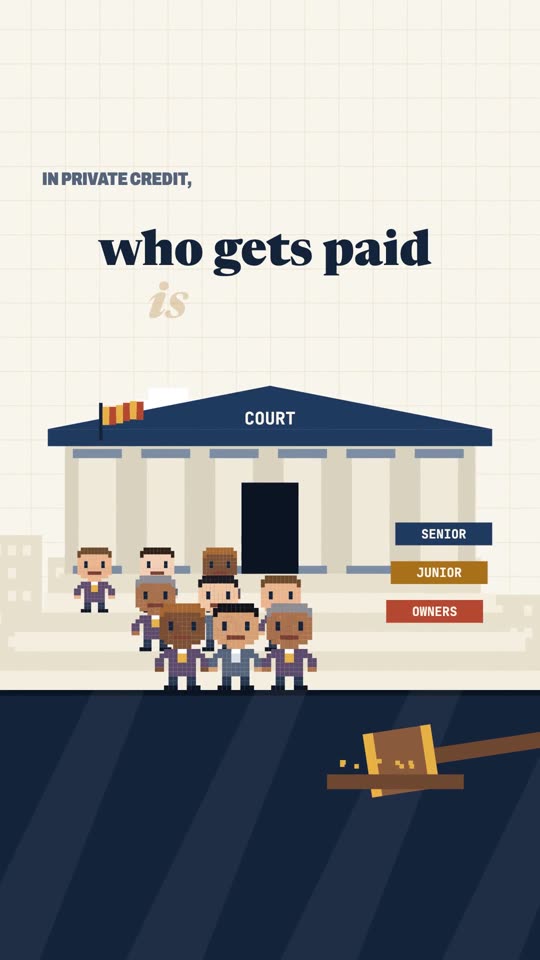
Watch · 39 seconds
A company goes under. Who gets paid is a queue.Seniority sets who gets repaid first. Senior debt must be repaid before junior debt, and owners stand behind the lenders. Junior debt usually pays a higher rate for standing further back.
Also: Two lenders, same collateral. One gets paid first., Who gets paid back second?
Check yourself
0 of 3 answered
Pick an answer to see why. Answer all 3 to finish the lesson.
3 questions left to finish the lesson.
Sources
The facts in this lesson were checked against these public pages on November 11, 2026. Examples use round invented numbers. Simple examples; terms vary by fund.
- 11 U.S. Code § 1129 (confirmation of a Chapter 11 plan), subsection (b), Legal Information Institute, Cornell Law School. The absolute priority rule, 1129(b)(2)(B): a plan imposed on a dissenting class of unsecured creditors must pay it in full or give nothing to claims and interests junior to it; dissenting secured classes are protected under 1129(b)(2)(A) through their liens and collateral.
- Private Credit: Characteristics and Risks (FEDS Notes, February 23, 2024; Fang Cai and Sharjil Haque), Board of Governors of the Federal Reserve System. Definition (debt-like, non-public instruments from non-bank lenders, mostly through funds and BDCs); nearly $1.7 trillion as of June 2023, direct lending about $800 billion or half; borrowers typically middle-market firms with $10 million to $1 billion of revenue; direct loans typically senior secured; about 15% hybrid loans, more junior; almost all floating rate; average maturity around five years, about 16% due in 2024; spreads above syndicated term loans; mean interest coverage about 2.0x vs 2.7x for leveraged loans (2023); default rates low vs syndicated loans through October 2023, not yet tested by a prolonged recession; post-default value around 33% vs 52% syndicated loans and 39% high-yield bonds (KBRA DLD); recent deals often without financial maintenance covenants (industry commentary); Form PF Q4 2021: pensions about 31% of private credit fund assets, other private funds 14%, insurers and individuals about 9% each; BDCs created by the Small Business Investment Incentive Act of 1980.
Definitions, not advice. Your answers are kept in this browser only.
See an error in this lesson?