In this lesson
- Terms: Gross and net returns, Management fee, Carried interest, Organizational expenses, SEC marketing rule
- To work through: a worked example, a 22-second film, 3 check questions
Underlined terms show their definition when you rest on them or tap them.
A gross return is what a fund’s investments earned before the management fee, fund expenses and carried interest. A net return is what investors kept after them. Both are real; they answer different questions. Gross shows how good the deals were. Net shows what an investor actually made.
The gap is made of three things. The management fee is paid every year, so it is called from investors but never invested. Fund expenses, such as the costs of setting up and running the fund, come out of investors’ money too. Carry takes a share of the profit once the hurdle is cleared. The longer and more successful the fund, the bigger the gap in dollars.
US rules bar SEC-registered advisers from advertising gross performance without net. Under the SEC’s marketing rule, an adviser may not show gross performance without net performance beside it, with at least equal prominence, over the same period and calculated the same way. Net performance there means after all the fees and expenses an investor paid or would have paid. (The rule’s requirement to show 1-, 5- and 10-year figures does not apply to private funds.)
A fund’s investments turn $100 million into $200 million: 2.0x gross. Over its life investors also pay $12 million of fees and expenses. Assume the hurdle is cleared and a full catch-up, so carry is 20% of investors’ profit.
| Investors pay in ($100m invested + $12m fees and expenses) | $112 million |
|---|---|
| Proceeds | $200 million |
| Profit before carry: $200m − $112m | $88 million |
| Carry: 20% of $88m | $17.6 million |
| Investors receive: $200m − $17.6m | $182.4 million |
| Net multiple: $182.4m ÷ $112m | about 1.63x |
The deals made 2.0x; the investors made about 1.63x. Simple example. Terms vary by fund.
Key takeaway: why it matters to investors
A manager’s track record is often first shown deal by deal, gross. What an investor keeps is net, and the difference compounds over a decade. Asking for net figures, on the same basis, is the first step in comparing two managers fairly.
Watch · 22 seconds
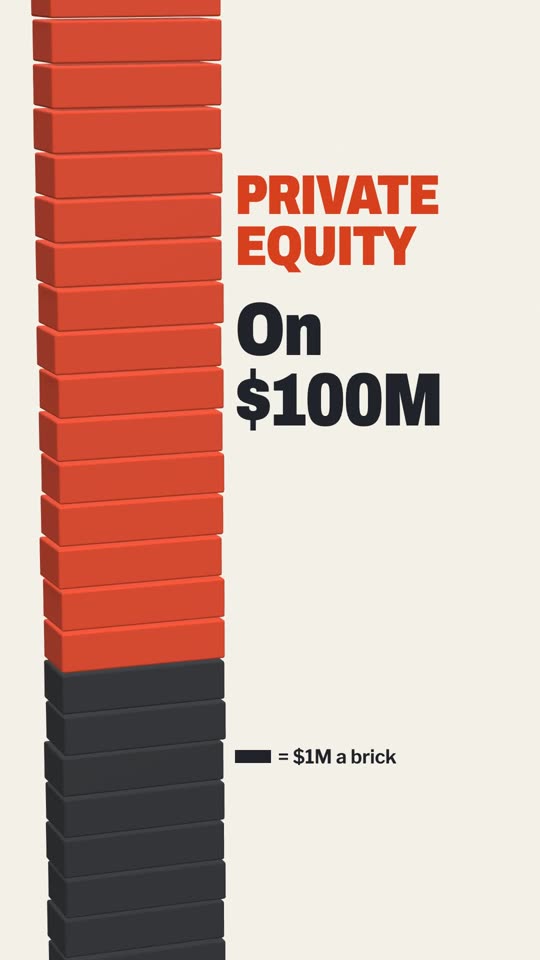
What 2 and 20 can cost on $100M2% a year in fees for ten years is $20M. 20% of $100M profit after fees is $20M more. One brick is $1M.
Check yourself
0 of 3 answered
Pick an answer to see why. Answer all 3 to finish the lesson.
3 questions left to finish the lesson.
Sources
The facts in this lesson were checked against these public pages on November 10, 2026. Examples use round invented numbers. Simple examples; terms vary by fund.
- 17 CFR 275.206(4)-1, Investment adviser marketing, Legal Information Institute, Cornell Law School (text of the SEC rule). An adviser’s advertisement may not show gross performance without net performance, with at least equal prominence, over the same period and with the same type of return and methodology; net performance is after all fees and expenses an investor paid or would have paid; the 1-, 5- and 10-year rule excludes private funds.
- Investment Adviser Marketing, U.S. Securities and Exchange Commission. The marketing rule prohibits gross performance unless net performance is also presented, and prohibits extracted performance without offering the total portfolio’s.
Definitions, not advice. Your answers are kept in this browser only.
See an error in this lesson?