In this lesson
- Terms: DPI, RVPI, TVPI, MOIC, NAV
- To work through: a worked example, a 24-second film, 3 check questions
Underlined terms show their definition when you rest on them or tap them.
DPI, distributions to paid-in, divides the cash returned by the cash paid in. At 1.0x investors have their money back; everything above is profit in hand.
RVPI, residual value to paid-in, divides NAV by paid-in. It is the part of the result that still depends on valuations.
TVPI, total value to paid-in, is the two added together: distributions plus NAV, over paid-in. It is the whole result so far. Early in a fund’s life TVPI is mostly RVPI; by the end, if all goes to plan, it is almost all DPI.
You will also see MOIC, multiple on invested capital. It is used in two ways: some treat it as another name for TVPI; others measure it on the money that went into the investments themselves, often per deal and before fees. Check which one a figure is.
The ratio chosen can change the verdict: a fund’s rank among its peers by TVPI or DPI need not match its rank by IRR.
The investor from lesson 1: $80 million paid in, $40 million received, $60 million share of NAV.
| DPI: $40m ÷ $80m | 0.5x |
|---|---|
| RVPI: $60m ÷ $80m | 0.75x |
| TVPI: $100m ÷ $80m | 1.25x |
The investor is up 25% so far, but has only half its money back in cash. Most of the gain is still on paper.
Key takeaway: why it matters to investors
A headline TVPI can look strong while almost nothing has come back. Reading DPI and RVPI beside it tells an investor how much of the result is banked and how much is still a forecast.
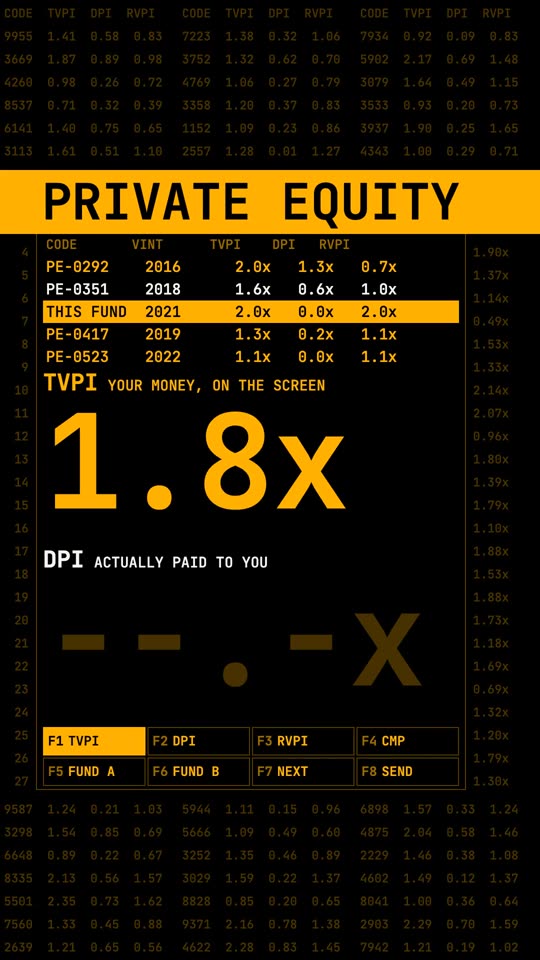
Watch · 24 seconds
You can't spend TVPITVPI counts cash back plus what's still on paper. DPI counts only the cash that reached you. Which fund would you rather own?
Also: A fund shows a gain. Most of it is not cash yet., Both doubled your money. One was far better.
Check yourself
0 of 3 answered
Pick an answer to see why. Answer all 3 to finish the lesson.
3 questions left to finish the lesson.
Sources
The facts in this lesson were checked against these public pages on November 10, 2026. Examples use round invented numbers. Simple examples; terms vary by fund.
- Understanding private equity performance (July 2026), Wellington Management. IRR as the discount rate that makes the net present value of all cash flows zero, weighting timing; TVPI (which it also calls MOIC) as realised plus unrealised value over invested capital; DPI as distributed over called capital; holdings often carried near cost early on.
- The private fund performance data dictionary: IRR, TVPI, DPI, RVPI and MOIC defined, Dakota. MOIC divides value by the capital put into the investments, excluding fees, expenses and uninvested capital; it appears far more often per company than per fund and is usually quoted gross, while TVPI is a net, fund-level measure.
Definitions, not advice. Your answers are kept in this browser only.
See an error in this lesson?