In this lesson
- Terms: Commitment, Capital call, NAV, Fair value, Capital account, Distribution in kind
- To work through: a worked example, a 24-second film, 3 check questions
Underlined terms show their definition when you rest on them or tap them.
Start with what investors actually sent the fund. Not their commitment, the sum they promised, but paid-in capital: the total of the capital calls they have met. Fees and expenses paid through calls count as paid in too, which is why a fund’s returns to investors are lower than the returns on its deals.
Next, what has come back: distributions, the cash (and occasionally shares) the fund has paid out from sales and income. This is money in investors’ hands.
Last, what the fund still holds, valued at its NAV, net asset value: the fund’s assets minus its liabilities. Private investments have no daily market price, so NAV rests on the manager’s valuations, usually reported each quarter. Under the accounting standards (IFRS 13, and ASC 820 in the US) they are meant to be at fair value: the price an asset would fetch in an orderly sale between market participants on the valuation date. Early on, holdings are often carried near what they cost until something gives a reason to revalue them.
Each investor’s share of all this is kept in its capital account. A fund’s quarterly report gives these figures for the fund and for each investor, and every performance number in the next six lessons is built from them.
An investor commits $100 million. Six years in:
| Commitment | $100 million |
|---|---|
| Paid in through calls (investments, fees, expenses) | $80 million |
| Distributions received | $40 million |
| Its share of NAV | $60 million |
| Still to be called | $20 million |
Cash in hand: $40 million on $80 million paid. On paper: another $60 million. The next lesson turns these into multiples.
Key takeaway: why it matters to investors
Investors can spend distributions; they cannot spend NAV. Keeping the three numbers apart is what lets a reader see how much of a reported gain is cash and how much is still the manager’s estimate.
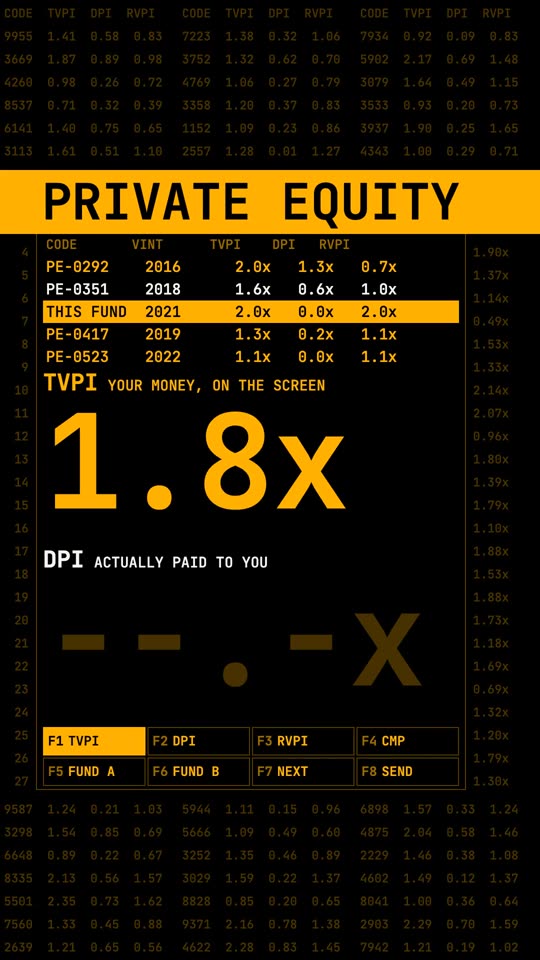
Watch · 24 seconds
You can't spend TVPITVPI counts cash back plus what's still on paper. DPI counts only the cash that reached you. Which fund would you rather own?
Check yourself
0 of 3 answered
Pick an answer to see why. Answer all 3 to finish the lesson.
3 questions left to finish the lesson.
Sources
The facts in this lesson were checked against these public pages on November 10, 2026. Examples use round invented numbers. Simple examples; terms vary by fund.
- IFRS 13 Fair Value Measurement (the US equivalent is FASB ASC 820), IFRS Foundation. Fair value is the price that would be received to sell an asset in an orderly transaction between market participants, an exit price under current market conditions.
- Understanding private equity performance (July 2026), Wellington Management. IRR as the discount rate that makes the net present value of all cash flows zero, weighting timing; TVPI (which it also calls MOIC) as realised plus unrealised value over invested capital; DPI as distributed over called capital; holdings often carried near cost early on.
Definitions, not advice. Your answers are kept in this browser only.
See an error in this lesson?