In this lesson
- Terms: Distribution in kind, J-curve, NAV, Fair value, Vintage year, Tender offer
- To work through: a worked example, a 17-second film, 3 check questions
Underlined terms show their definition when you rest on them or tap them.
A fund returns money as it sells what it owns, and sometimes from income such as interest or dividends. Each payout is a distribution, shared out through the waterfall. Most are cash. When a company the fund owns has listed, the fund may instead hand investors the shares, a distribution in kind, leaving each one to decide when to sell.
Because sales come late, cash flows run in a pattern: money goes out in the early years as calls, and comes back in the later years as distributions. An investor’s net cash position usually dips for years before it recovers.
Reported returns follow a similar shape, the J-curve. Fees and set-up costs are charged from the start, while new investments are usually carried at or near what they cost until something, such as a sale or a new funding round, gives a reason to revalue them. So a young fund often shows a negative return on paper. As investments are written up or sold, a successful fund climbs above zero, and the line looks like the letter J.
Wellington Management, an investment manager, puts it plainly: negative net performance early in a fund’s life does not necessarily mean the underlying investments are doing badly. A young fund with little or no dip often reflects a subscription line delaying calls, or investments written up early.
A $100 million fund, one year in. It has called $25 million: $23 million went into two companies, $2 million paid fees and costs.
| Paid in by investors | $25 million |
|---|---|
| Companies, held at cost | $23 million |
| Value on paper | $23 million |
| Return on paper | −8% |
Nothing has gone wrong: the fees are spent and the companies have not yet had time to grow. That is the bottom of the J.
Key takeaway: why it matters to investors
The J-curve tells investors how to read a young fund: red numbers in the early years are expected, and cash comes back late. It is also why LPs plan years of calls before any money returns, and why a fund’s vintage matters when comparing it with others.
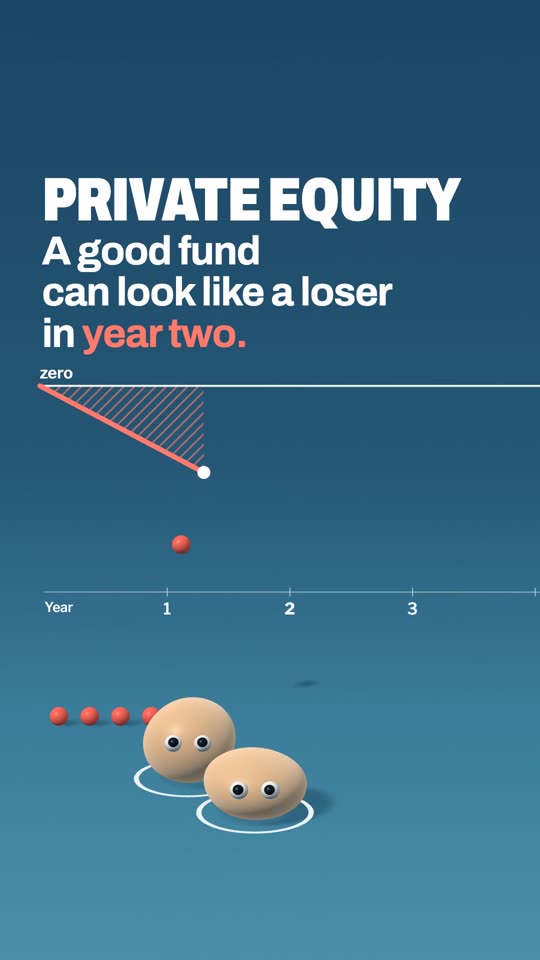
Watch · 17 seconds
Why good funds look bad in year twoFees start on day one, and new deals sit at about cost, so a fund starts out down on paper. Then companies grow and get sold. That shape is the J-curve.
Also: A fund owes you money. It sends you this instead., Why a fund's birth year changes how good its returns look
Check yourself
0 of 3 answered
Pick an answer to see why. Answer all 3 to finish the lesson.
3 questions left to finish the lesson.
Sources
The facts in this lesson were checked against these public pages on November 10, 2026. Examples use round invented numbers. Simple examples; terms vary by fund.
- Understanding private equity performance (July 2026), Wellington Management. Why early net returns are negative (fees while holdings sit near cost) and not necessarily a sign of poor investments; definitions of IRR, TVPI and DPI.
Definitions, not advice. Your answers are kept in this browser only.
See an error in this lesson?