In this lesson
- Terms: Carried interest, Hurdle rate, GP catch-up, Distribution waterfall, European waterfall, American waterfall, Clawback, Carry escrow
- To work through: a worked example, a 47-second film, 3 check questions
Underlined terms show their definition when you rest on them or tap them.
Carried interest, or carry, is the manager’s share of a fund’s profits, its reward for performance. 20% is the standard rate: Callan called it the industry standard in its 2020 study of 90 private equity funds marketed in 2018 and 2019, mostly North American buyout funds. Carry is paid only once investors have their money back (on the whole fund, or on each deal sold, depending on the waterfall) and, in most funds, a minimum return on it.
The order is set by the distribution waterfall in the LPA. In a whole-fund (European) waterfall it runs: first, investors get back everything they paid in; second, they get the preferred return, or hurdle rate, typically 8% a year; third, a GP catch-up gives the manager most or all of the next cash until it has its full share of the profit so far; fourth, everything after that is split, typically 80% to investors and 20% to the manager. Callan found 8% the usual hurdle and none above it, while 13% of the funds, mostly growth and venture, had none.
Funds differ on when carry is measured. In a whole-fund, or European waterfall, investors must get back all their capital plus the preferred return across the whole fund before carry is paid; ILPA calls this best practice. In a deal-by-deal, or American waterfall, the same steps run on each sale as it happens, so the manager can take carry on early winners. Callan found about two-thirds of the funds it studied paid carry deal by deal (64%), about a third whole-fund (32%) and the rest a hybrid. Because early winners can be followed by losers, deal-by-deal funds need a clawback, which makes the manager return carry it was overpaid.
A whole-fund waterfall. Investors paid in $100 million. Over the fund’s life it pays out $180 million. By the time of the payouts, the 8% preferred return comes to $30 million. 20% carry, full catch-up.
| 1. Investors get their money back | $100 million |
|---|---|
| 2. Investors get the preferred return | $30 million |
| 3. Catch-up to the manager | $7.5 million |
| 4. The last $42.5 million, split 80/20 | $34 million to investors, $8.5 million to the manager |
| Investors in all | $164 million |
| Manager’s carry in all | $16 million, 20% of the $80 million profit |
The catch-up of $7.5 million is what gives the manager 20% of the $37.5 million of profit paid out by that point. Simple example: it ignores the GP’s own commitment and fees. Terms vary by fund.
Key takeaway: why it matters to investors
Carry is the term that ties the manager’s pay to investors’ results, and its details decide how closely. The hurdle, the catch-up and whether carry is whole-fund or deal by deal all change when the manager is paid and how much risk investors carry if later deals go wrong.
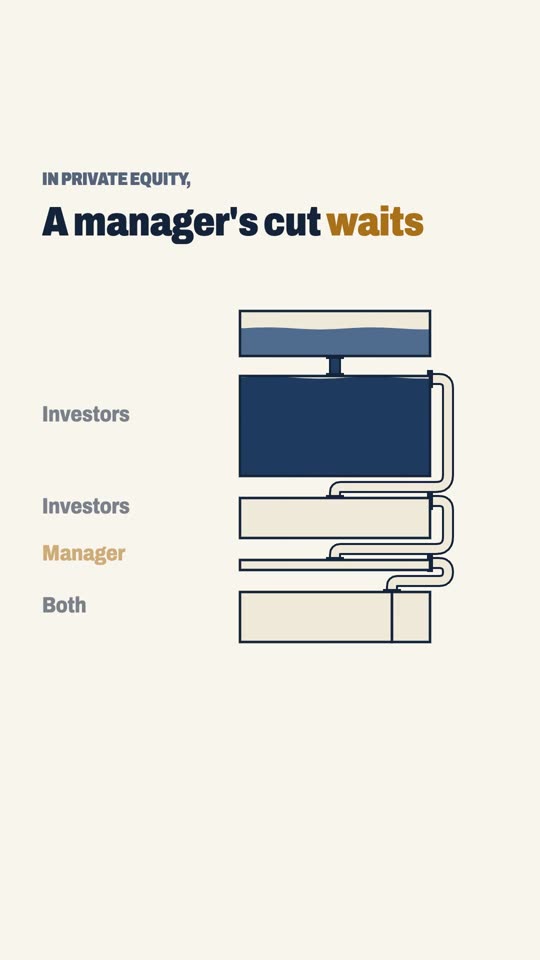
Watch · 47 seconds
A manager's cut usually waits behind the investorsIn a typical private equity waterfall, investors get their money back and a preferred return before the manager takes its share of the profit. If less cash comes back, the manager's share can be zero. Simple example, before fees. Terms vary by fund.
Also: An 8% preferred return is not a guarantee, The stretch where the manager gets every dollar, Same profit. One manager gets paid years earlier., When the manager has to give money back
Check yourself
0 of 3 answered
Pick an answer to see why. Answer all 3 to finish the lesson.
3 questions left to finish the lesson.
Sources
The facts in this lesson were checked against these public pages on November 10, 2026. Examples use round invented numbers. Simple examples; terms vary by fund.
- Private Equity Fees and Terms Study (July 2020; 90 funds in market in 2018-19, 76% buyout, mostly North American), Callan. Investment period typically five or six years; median fee 1.75% of commitments in it and 1.50% of invested capital after; 17% had no step-down; fee offsets in every fund, 96% at 100%; carry 20% the standard; hurdle typically 8%, 13% of funds none; waterfalls 64% American (deal by deal), 32% European (whole fund), 4% hybrid; GP commitment 3% the standard.
- ILPA Principles 3.0 (June 2019), GP and Fund Economics: waterfall, carried interest, subscription lines, Institutional Limited Partners Association. Whole-of-fund (all contributions plus preferred return back first) is best practice; preferred return runs from when capital is at risk; subscription lines as short bridges, e.g. under 180 days and 20% of commitments.
- ILPA Principles 3.0 (June 2019), recycling and clawback, Institutional Limited Partners Association. Recycling should be capped and end with the investment period; an all-capital-back waterfall is the best way to minimise clawback.
- ILPA Principles 3.0 (June 2019), fund term and structure, Institutional Limited Partners Association. Extensions in one-year steps, at most two, approved by the LPAC and then a supermajority of LPs; the GP commitment should be in cash.
Definitions, not advice. Your answers are kept in this browser only.
See an error in this lesson?