In this lesson
- Terms: PPM, LPA, Side letter, MFN clause, First close, Final close, Hard cap, Anchor investor, Placement agent
- To work through: a worked example, a 25-second film, 3 check questions
Underlined terms show their definition when you rest on them or tap them.
Before a fund takes any money, the manager writes its documents. The PPM, or private placement memorandum, is the offering document: the strategy, the team, the terms and the risks. The LPA is the contract that binds the partners. Investors sign a subscription agreement to come in, and their lawyers usually negotiate the LPA. A large investor may also get a side letter, a separate agreement with terms of its own such as a lower fee or extra reporting.
The fund begins at its first close: the first time it accepts commitments and gets going, even though it has not reached its target. It can start investing from that day. The manager then keeps marketing, and further closes admit new investors, over a period that is often around a year and is set in the LPA.
Investors who join at a later close are usually drawn down to the same level as the existing investors, and often pay an interest charge for the earlier investors’ benefit, so everyone ends up as if they had joined at the first close. That is called equalisation.
Raising ends at the final close. After it no one else can join, and the fund’s size is fixed; that is the number in the news and in league tables. Many funds also set a hard cap, the most the documents allow it to raise, often somewhat above the target; going past it usually means amending the partnership agreement. A fund that closes at its hard cap is usually a sign of strong demand.
A manager targets $1 billion, with a $1.25 billion hard cap.
| First close | $400 million |
|---|---|
| Second close, five months later | $350 million |
| Final close, a year after the first | $450 million |
| Final size | $1.2 billion |
The fund beat its target and stopped below its hard cap. Investors in the later closes paid in their share of the calls already made, so they hold the same position as if they had joined at the first close.
Key takeaway: why it matters to investors
The closes tell investors and the market how a raise is going: a quick final close at the hard cap is a sign of demand, a long raise or a cut target is a sign of the opposite. The documents set the terms an investor lives with for the next decade, which is why they are negotiated line by line.
Watch · 25 seconds
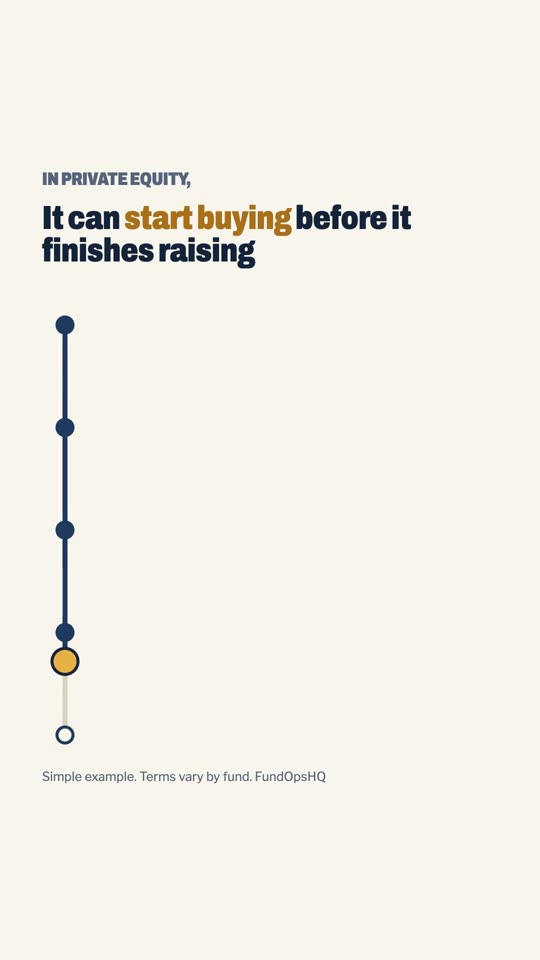
A fund can start investing before it finishes raisingA first close is the first time a fund accepts commitments and gets going, even though it keeps raising toward its target.
Also: A fund's size isn't known until the door shuts, Investors offered $4B. The fund couldn't take it.
Check yourself
0 of 3 answered
Pick an answer to see why. Answer all 3 to finish the lesson.
3 questions left to finish the lesson.
Sources
The facts in this lesson were checked against these public pages on November 10, 2026. Examples use round invented numbers. Simple examples; terms vary by fund.
- Private Equity Fund Timeline (presentation, August 2014), Duane Morris LLP. First (initial) closing, further closings over around a year, final closing; investors negotiate the partnership agreement and side letters.
- Credit funds: transfers between related funds and accounts, equalisation and RAM, Macfarlanes LLP. Later-closing investors are drawn down to the same extent as existing ones and pay equalisation interest for existing investors’ benefit.
- Fund Size: Targets, Caps, Minimums, and Reductions (VC & PE Funds Deskbook), Morgan Lewis. The fund cap is the absolute maximum of commitments the fund may accept, often about 10% above the target, and typically cannot be exceeded without amending the partnership agreement.
Definitions, not advice. Your answers are kept in this browser only.
See an error in this lesson?