In this lesson
- Terms: DPI, TVPI, RVPI, IRR, MOIC, NAV, Vintage year, Public market equivalent (PME), Top quartile, Gross and net returns
- To work through: 2 worked examples, a toy to try, a 24-second film, 3 check questions
Underlined terms show their definition when you rest on them or tap them.
All three start from paid-in capital: what investors have actually sent the fund through calls, not what they committed.
DPI, distributions to paid-in, is the cash returned divided by the cash paid in. A DPI of 1.0x means investors have their money back. It is the only one of the three made purely of cash, so it carries more weight as a fund ages.
TVPI, total value to paid-in, adds what the fund still holds (its net asset value, or NAV) to the cash already returned, and divides by paid-in. The unrealised part is RVPI: TVPI equals DPI plus RVPI. TVPI shows the whole result so far, but the part still held rests on the manager’s own valuations until it is sold.
IRR, the internal rate of return, is the yearly rate that accounts for when money went in and came out. The same profit earned faster gives a higher IRR, which is why early sales or a subscription line can lift it. Multiples ignore time; IRR rewards it. Investors read them together, and compare a fund with others of the same vintage year, or against a public market index with a public market equivalent (PME).
Investors have paid in $80 million. The fund has returned $100 million and still holds investments valued at $20 million.
| DPI: $100m ÷ $80m | 1.25x |
|---|---|
| RVPI: $20m ÷ $80m | 0.25x |
| TVPI: $120m ÷ $80m | 1.5x |
Investors already have more cash back than they paid in; a quarter of a turn more is still on paper.
$100 million goes in at the start and $200 million comes back in one payment. Both cases have a 2.0x multiple.
| Paid back after 5 years | IRR about 15% |
|---|---|
| Paid back after 3 years | IRR about 26% |
Same multiple, very different IRR: speed is what IRR measures. Simple example. Terms vary by fund.
Put $100 million in, get it back once. Move the sliders.
$100 million in, $200 million back after 5 years: an IRR of about 15% a year.
| 2.0x over | Bar | IRR |
|---|---|---|
| 3 years | 26% | |
| 5 years | 15% | |
| 7 years | 10% | |
| 10 years | 7% |
The multiple says how much came back; IRR says how fast. A 1.0x multiple is 0% however long it takes. Simple example: one payment in, one out, no fees.
Key takeaway: why it matters to investors
These numbers are how investors decide whether to back a manager’s next fund. Knowing that DPI is cash, that TVPI leans on valuations and that IRR rewards speed is what lets a reader see through a headline return.
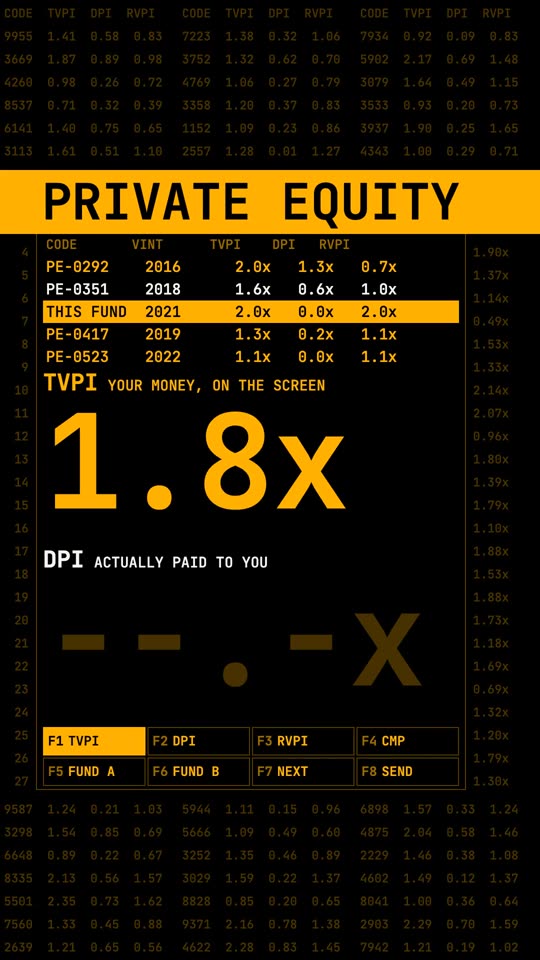
Watch · 24 seconds
You can't spend TVPITVPI counts cash back plus what's still on paper. DPI counts only the cash that reached you. Which fund would you rather own?
Also: Both doubled your money. One was far better., A fund shows a gain. Most of it is not cash yet., A fund’s return means little until you compare it to the market
Check yourself
0 of 3 answered
Pick an answer to see why. Answer all 3 to finish the lesson.
3 questions left to finish the lesson.
Sources
The facts in this lesson were checked against these public pages on November 10, 2026. Examples use round invented numbers. Simple examples; terms vary by fund.
- Understanding private equity performance (July 2026), Wellington Management. Why early net returns are negative (fees while holdings sit near cost) and not necessarily a sign of poor investments; definitions of IRR, TVPI and DPI.
- ILPA Principles 3.0 (June 2019), GP and Fund Economics: waterfall, carried interest, subscription lines, Institutional Limited Partners Association. Whole-of-fund (all contributions plus preferred return back first) is best practice; preferred return runs from when capital is at risk; subscription lines as short bridges, e.g. under 180 days and 20% of commitments.
Definitions, not advice. Your answers are kept in this browser only.
See an error in this lesson?