In this lesson
- Terms: Management fee, Fee step-down, Management fee offset, Organizational expenses, Gross and net returns
- To work through: a worked example, a 22-second film, 3 check questions
Underlined terms show their definition when you rest on them or tap them.
The management fee is a yearly charge, paid out of the fund, that covers the manager’s cost of running it: the team, offices, travel and research. ILPA says it should be based on those normal operating costs, and that a first-time manager, or one charging more than average, should show investors a budget for it.
Two numbers set it. The rate is a percentage; the base is what it is a percentage of. During the investment period the base is usually investors’ total commitments, so the fee is the same in year one, when little has been invested, as in year four. Afterwards it usually steps down to a lower rate, a smaller base or both: commonly the cost of the investments the fund still holds. This fee step-down reflects that the manager is no longer finding new deals.
Callan’s 2020 study of 90 private equity funds marketed in 2018 and 2019, mostly North American buyout funds, found a median fee of 1.75% of commitments during the investment period and 1.50% of invested capital after it; 17% of the funds had no step-down. “Two and twenty”, a 2% fee and 20% carry, is the old shorthand; terms vary by fund, size and strategy.
Managers sometimes charge the companies a fund owns for deals, monitoring or board seats. A management fee offset reduces the management fee by those amounts, so the investors, not the manager, get the benefit. Every fund in Callan’s study had one, and 96% offset 100%. Separately, the fund pays its own expenses, such as the cost of setting it up, which LPAs usually cap (organizational expenses).
A $400 million fund charges 1.75% of commitments for five years, then 1.5% of the cost of what it still holds.
| Fee each year, years 1 to 5 | $7 million |
|---|---|
| Total over the investment period | $35 million |
| Cost of investments held in year 6 | $250 million |
| Fee in year 6 | $3.75 million |
The fee nearly halves when the base moves from commitments to what is still invested.
Key takeaway: why it matters to investors
The fee is the one cost an investor pays whatever happens, and over a decade it adds up to a meaningful slice of commitments. Small differences in rate, base and step-down move net returns, which is why investors compare them first.
Watch · 22 seconds
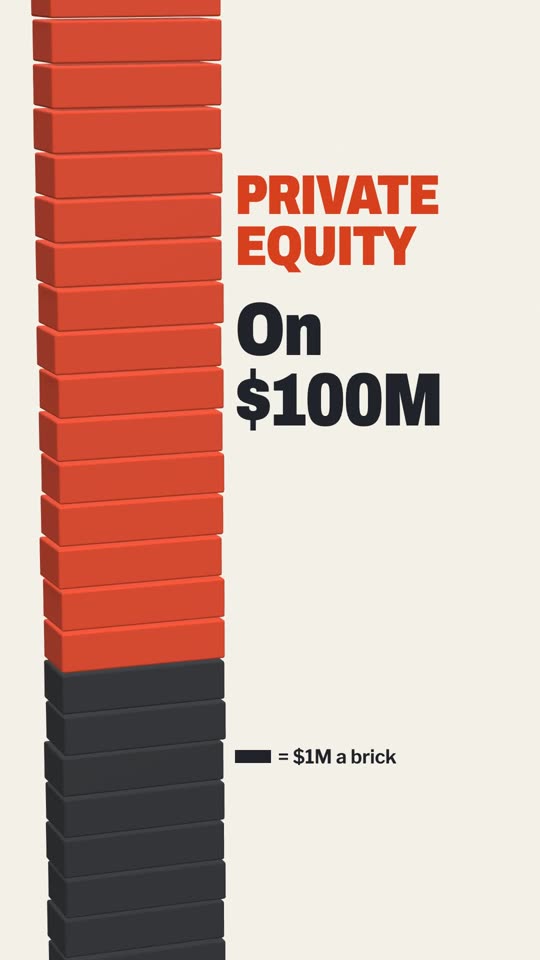
What 2 and 20 can cost on $100M2% a year in fees for ten years is $20M. 20% of $100M profit after fees is $20M more. One brick is $1M.
Also: The same fund, and the fee falls by half, A manager can bill the companies it owns
Check yourself
0 of 3 answered
Pick an answer to see why. Answer all 3 to finish the lesson.
3 questions left to finish the lesson.
Sources
The facts in this lesson were checked against these public pages on November 10, 2026. Examples use round invented numbers. Simple examples; terms vary by fund.
- ILPA Principles 3.0 (June 2019), management fees, Institutional Limited Partners Association. The fee should cover the manager’s normal operating costs (staff, offices, travel); it should step down after the investment period to a percentage of unrealised cost.
- Private Equity Fees and Terms Study (July 2020; 90 funds in market in 2018-19, 76% buyout, mostly North American), Callan. Investment period typically five or six years; median fee 1.75% of commitments in it and 1.50% of invested capital after; 17% had no step-down; fee offsets in every fund, 96% at 100%; carry 20% the standard; hurdle typically 8%, 13% of funds none; waterfalls 64% American (deal by deal), 32% European (whole fund), 4% hybrid; GP commitment 3% the standard.
- ILPA Principles 3.0 (June 2019), fee income beyond the management fee, Institutional Limited Partners Association. Any fees charged to portfolio companies should be 100% offset against the management fee.
- ILPA Principles 3.0 (June 2019), organization and partnership expenses, Institutional Limited Partners Association. Formation costs should be capped, with any excess offset against the management fee.
Definitions, not advice. Your answers are kept in this browser only.
See an error in this lesson?