In this lesson
- Terms: Commitment, Capital call, Defaulting LP, Subscription line, Capital account, Pacing plan
- To work through: a worked example, a 16-second film, 3 check questions
Underlined terms show their definition when you rest on them or tap them.
When an LP joins a fund it signs a commitment: a legal promise to provide up to a set sum over the fund’s life. Very little of it is paid on the day. The manager draws it down in stages with a capital call, a notice asking each investor for its share of what the fund needs, usually to buy an investment or pay fees and expenses. The notice period is set in the LPA.
Calls go out pro rata: every LP pays the same percentage of its commitment. What has not yet been called is the investor’s unfunded commitment: money it must still be ready to send.
This is why private fund investors have to plan their cash. A call can arrive at any time, and the LPA sets stiff penalties for a defaulting LP that does not pay. Delaware’s statute lets the agreement cut or wipe out the defaulter’s interest, rank it behind the others, or force its sale. Those penalties are what make commitments dependable for the GP and for anyone lending to the fund.
Many funds also borrow for short periods against those unfunded commitments, through a subscription line. The fund buys with the borrowed money and calls the LPs later to repay it. ILPA, the LPs’ trade body, says such lines should be short bridges, giving as examples no more than 180 days and no more than 20% of commitments, and not mainly a way to lift the fund’s reported IRR.
An LP commits $20 million. In year one the fund calls 15% of commitments, then 10% more.
| First call (15%) | $3 million |
|---|---|
| Second call (10%) | $2 million |
| Paid in so far | $5 million |
| Unfunded commitment | $15 million |
The LP has paid a quarter of what it promised and must keep $15 million ready to send when asked.
Key takeaway: why it matters to investors
A commitment is a promise, not cash in the fund, and the gap between the two shapes an investor’s whole programme: how much to keep liquid, how much to commit next year, and how far a fund’s early returns depend on when the money was actually called.
Watch · 16 seconds
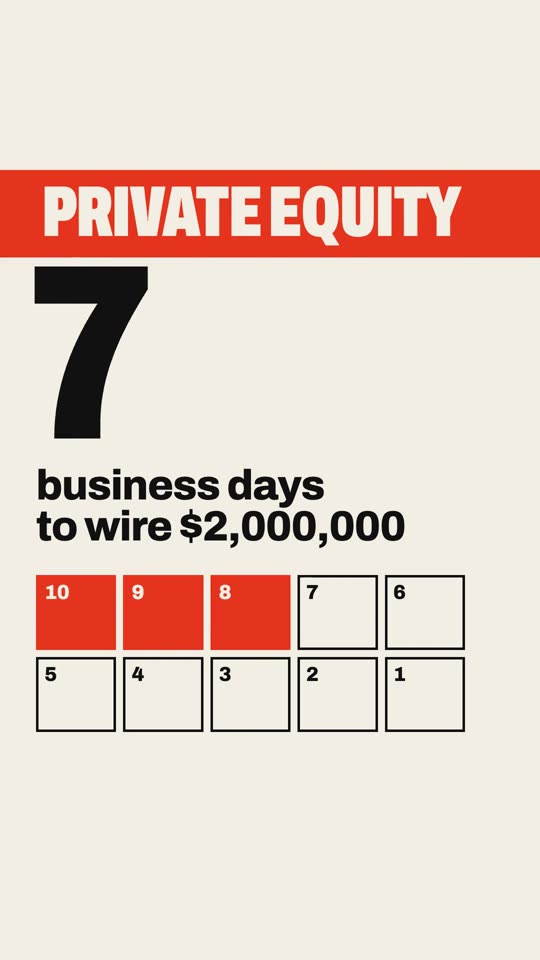
10 business days to wire $2M: the capital callYou don't pay a fund up front. You promise an amount, and the manager calls pieces of it as deals come up. Miss a call and you could lose part of your stake.
Also: A fund can buy a company before investors send a dollar, You committed $100M. $60M is in. What do you still owe?
Check yourself
0 of 3 answered
Pick an answer to see why. Answer all 3 to finish the lesson.
3 questions left to finish the lesson.
Sources
The facts in this lesson were checked against these public pages on November 10, 2026. Examples use round invented numbers. Simple examples; terms vary by fund.
- Delaware Code, Title 6, Chapter 17, Subchapter V (Finance), § 17-502(c), State of Delaware. A partnership agreement may penalise a partner who misses a required contribution: reduce or eliminate its interest, subordinate it, force its sale, or forfeit it.
- ILPA Principles 3.0 (June 2019), GP and Fund Economics: waterfall, carried interest, subscription lines, Institutional Limited Partners Association. Whole-of-fund (all contributions plus preferred return back first) is best practice; preferred return runs from when capital is at risk; subscription lines as short bridges, e.g. under 180 days and 20% of commitments.
Definitions, not advice. Your answers are kept in this browser only.
See an error in this lesson?